
Artificial intelligence is no longer science fiction. It runs your phone, suggests your movies, detects fraud in your bank account, and powers self-driving cars. Because of this explosion, AI engineer salary numbers have reached record highs in the United States.
In 2026, artificial intelligence is no longer limited to Silicon Valley. Companies across Europe, the Middle East, and Asia are aggressively hiring AI engineers to build machine learning systems, automation tools, and scalable AI applications. While the United States remains the highest-paying market, global competition for AI talent continues to increase.
Companies compete fiercely for professionals who understand artificial intelligence, machine learning, deep learning, and data science. If you are thinking about entering this field, one question matters most: how much do AI engineers earn in 2026?
This guide provides a complete global breakdown for the USA market, covering salary ranges, industry trends, career growth, and the real earning potential of AI professionals.
Artificial Intelligence Engineer Salary in 2026 ranges from $95,000 to over $200,000 annually in the US depending on experience, industry, and specialization in machine learning, deep learning, and AI deployment.
Must read about: Adult BMI Categories in 2025: A Complete Guide for the USA
Table of Contents
╔══════════════════════════════════╗
║ 1. What Is the Average AI Engineer Salary? ║
║ 2. AI Salary by Experience Level ║
║ 3. AI Salary by Job Role ║
║ 4. AI Salary by Industry ║
║ 5. AI Salary by Country ║
║ 6. Skills That Increase AI Salary ║
║ 7. How to Become a High-Paid AI Engineer ║
║ 8. Future of AI Careers ║
║ 9. FAQs ║
╚══════════════════════════════════╝
Artificial intelligence is no longer science fiction. It runs your phone, suggests your movies, detects fraud in your bank account, and powers self-driving cars. Because of this explosion, AI engineer salary numbers have reached record highs in the United States.
Companies compete fiercely for professionals who understand artificial intelligence, machine learning, deep learning, and data science. If you are thinking about entering this field, one question matters most: how much do AI engineers earn in 2026?
This guide gives you the complete answer.
What Is the Average AI Engineer Salary?
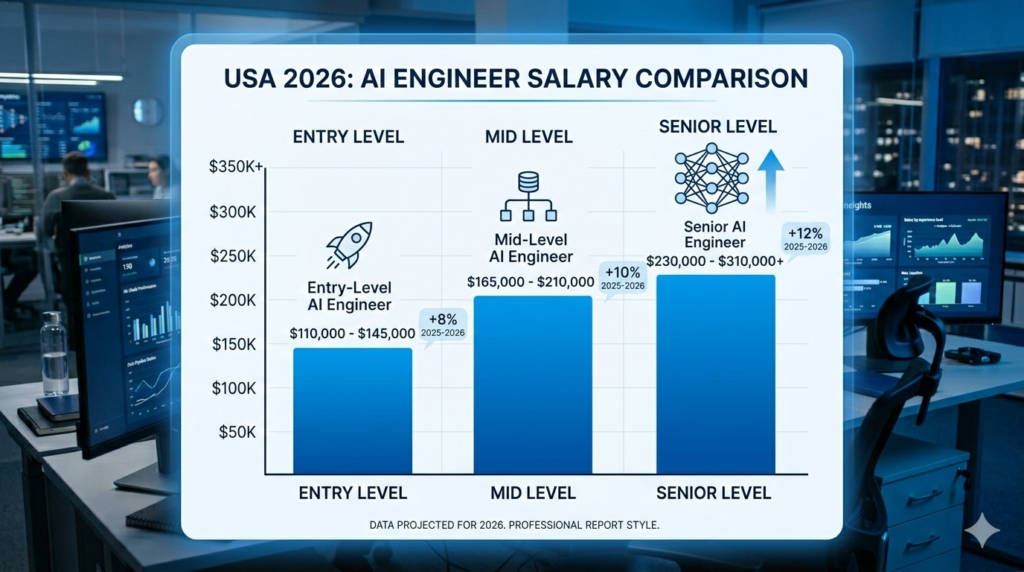
The average Artificial Intelligence Engineer Salary in the United States in 2026 ranges between $125,000 and $185,000 per year. In top tech cities like San Francisco or New York, total compensation often crosses $210,000 with bonuses and stock options.
That figure reflects rising AI job demand. Businesses rely heavily on machine learning models, deep learning algorithms, and predictive modeling to drive growth. As a result, the overall artificial intelligence salary continues to outpace most tech careers.
AI engineer salary overview table (USA 2026)
| Level | Base Salary | Bonus + Equity | Total Compensation |
| Entry-Level | $95,000 | $10,000 | $105,000 |
| Mid-Level | $135,000 | $20,000 | $155,000 |
| Senior | $170,000 | $40,000 | $210,000 |
| Lead / Architect | $190,000 | $60,000+ | $250,000+ |
When compared to traditional software roles, AI jobs salary figures are higher. Why? Because these engineers build complex neural networks, handle big data, and manage advanced AI deployment systems on cloud platforms (AWS, Azure, GCP).
AI Salary by Experience Level
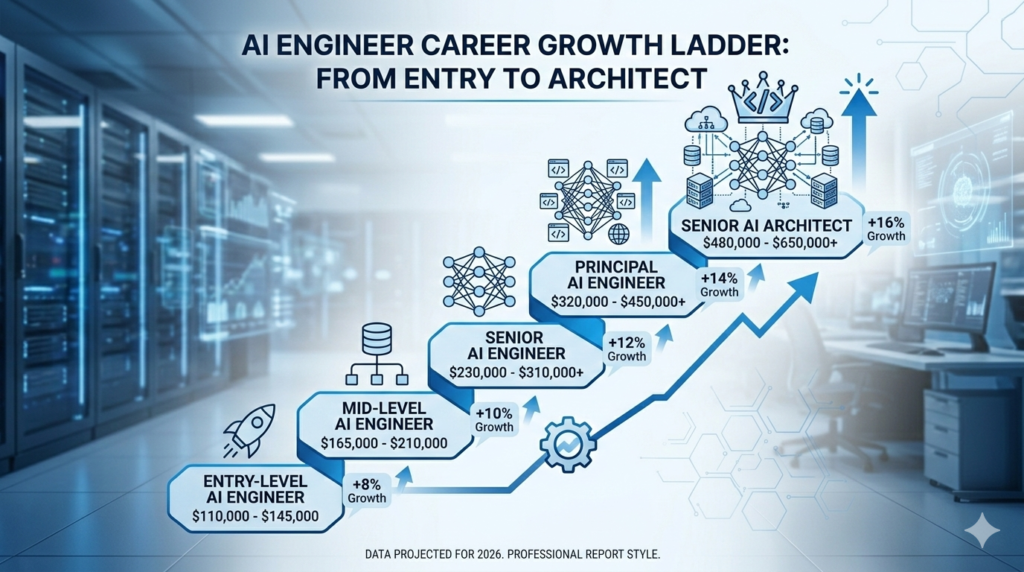
Experience changes everything. The AI salary by experience increases rapidly because expertise in model training, data engineering, and AI automation solutions becomes rare at senior levels.
Entry-level engineers usually support senior teams. They work on Python programming, debugging algorithms, and testing AI tools. Mid-level engineers start designing full systems. Senior engineers lead product decisions and manage AI product development strategies.
AI Salary per Month (USA)
| Experience | Annual Salary | AI Salary Per Month |
| 0–2 Years | $95,000 | $7,900 |
| 3–5 Years | $135,000 | $11,250 |
| 6–10 Years | $170,000 | $14,200 |
| 10+ Years | $200,000+ | $16,600+ |
Many professionals ask, Can AI engineers earn $200k? Yes. Senior specialists in natural language processing, computer vision, or robotics frequently cross that mark.
The AI engineer pay scale grows fastest for those who understand AI deployment pipelines and scalable infrastructure.
AI Salary by Job Role

Not all AI roles pay the same. Specialization increases value.
machine learning engineer salary
A machine learning engineer salary in the US ranges from $120,000 to $185,000. These professionals design machine learning models, optimize algorithms, and manage model training cycles. Companies value engineers who master TensorFlow developer frameworks or work as a PyTorch engineer.
You will be must like reading about: Convert Seconds to Days: The Ultimate 2025 Guide
data scientist salary
The average data scientist salary sits between $110,000 and $165,000. Data scientists focus more on analytics, predictive analytics, and interpreting big data. They collaborate closely with AI engineers but emphasize insights over deployment.
AI software engineer salary
The AI software engineer salary averages $130,000 to $190,000. These engineers connect AI systems to real-world products. They handle backend logic, APIs, and AI deployment across cloud computing platforms.
AI research scientist salary
An AI research scientist salary can exceed $200,000, especially in tech giants or research labs. These professionals push boundaries in AI research, deep learning algorithms, and experimental neural networks.
AI developer salary
An AI developer salary usually ranges from $115,000 to $170,000. Developers focus on practical AI applications such as recommendation systems or chatbot systems built on natural language processing (NLP).
highest paying AI jobs
The highest paying AI jobs include AI Architect, Head of AI, Principal Scientist, and Senior computer vision engineer. Compensation in these roles can exceed $250,000 annually.
AI Salary by Industry

The AI salary by industry varies widely. Some sectors depend heavily on automation.
In fintech AI, engineers design fraud detection systems using predictive modeling and machine learning. Salaries often reach the top tier. In healthcare AI, professionals build diagnostic tools powered by deep learning and natural language processing. Demand remains strong due to innovation.
Manufacturing invests in robotics and AI automation solutions. Retail relies on recommendation systems. Each sector drives salary differently based on complexity.
Case Study: FinTech AI Salary Surge
Explain how a fintech company increased fraud detection accuracy using neural networks and paid $185,000 to senior AI engineers due to business impact.
Industry Comparison Table
| Industry | Average Salary |
| Big Tech | $180,000+ |
| FinTech AI | $170,000 |
| Healthcare AI | $160,000 |
| Robotics | $165,000 |
| E-Commerce | $150,000 |
| Startups | $155,000 |
AI startup salaries often include equity. While base pay may be slightly lower, stock options can increase long-term earnings.
AI Salary by Country

Although this guide targets the US, understanding global AI salary trends adds perspective.
Global Comparison Table
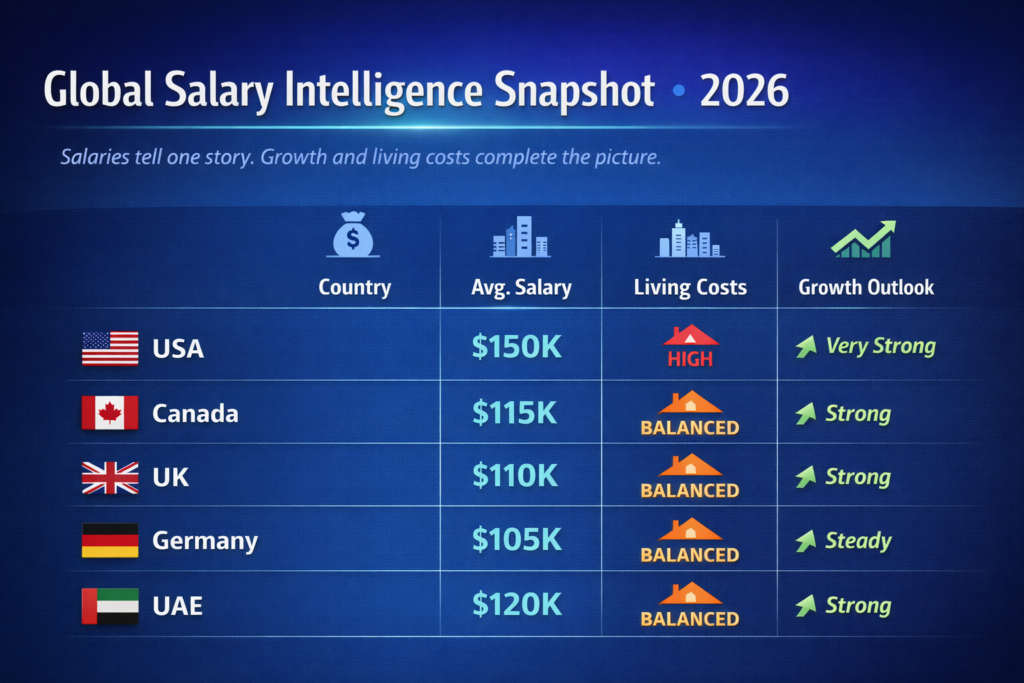
Global opportunity isn’t just about headline salaries. It’s about how income, living costs, and market momentum intersect to shape real earning power. The United States and Singapore lead with $150K and $130K average salaries, yet both carry high living expenses. Canada, the UK,
Germany, and the UAE sit in a more balanced zone where compensation stays competitive while cost pressure eases slightly. That balance matters. A strong salary in a moderate-cost economy often stretches further than a higher paycheck in an expensive city.
However, growth outlook changes the equation. Markets labeled “Very Strong” signal expansion, hiring momentum, and long-term upside. Strong growth creates leverage for negotiation, career mobility, and faster progression.
Steady growth offers stability and predictable advancement. When you weigh all three pillars together—income level, cost structure, and expansion velocity—you don’t just see where money looks good. You see where opportunity compounds. That’s the real global advantage.
The AI salary worldwide remains highest in the United States. Silicon Valley continues to dominate due to venture funding and aggressive hiring.
When companies hire remote engineers, compensation may adjust based on location. However, US-based talent typically earns the most.
Global AI Salary Trends in 2026
Explain how artificial intelligence adoption differs by region. Mention that the US leads due to venture capital funding and Big Tech dominance. Then explain that Europe offers stable salaries but lower bonuses. Mention the Middle East investing heavily in AI transformation. Add Asia’s rapid AI growth in China and India.
Remote AI Engineer Salary Worldwide
Explain how remote work has changed global AI salary structures. Mention that companies now hire internationally but adjust pay based on region. Explain how US-based remote engineers still command higher compensation.
Skills That Increase AI Salary
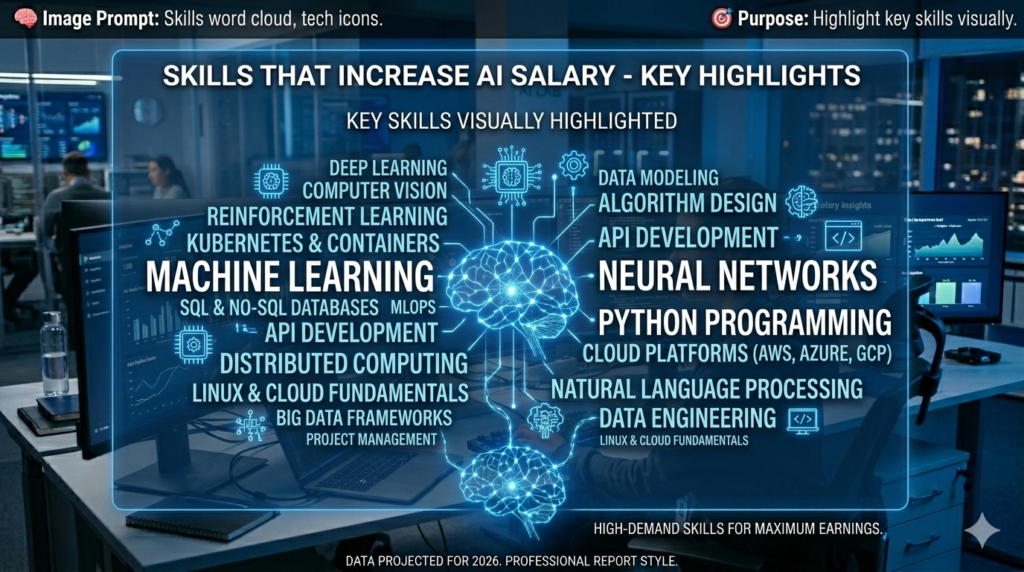
Skills determine your income more than your degree.
Engineers who master machine learning models, deep learning algorithms, and natural language processing command higher salaries. Expertise in data engineering and scaling systems across cloud platforms (AWS, Azure, GCP) also increases value.
Professionals with advanced degrees such as MS in Artificial Intelligence or strong foundations from AI degree programs often enter higher salary bands. Some start with a B.Tech Artificial Intelligence background before specializing.
Also read about: Tool Converter – Your Free Online Conversion Hub
Technical Skills That Raise AI Career Salary
| Skill | Impact on Salary |
| Python programming | High |
| Neural networks | Very High |
| AI deployment | Very High |
| Data engineering | High |
| Computer vision | Very High |
In addition, earning recognized AI certifications demonstrates commitment. Employers respect proof of skills.
How to Become a High-Paid AI Engineer
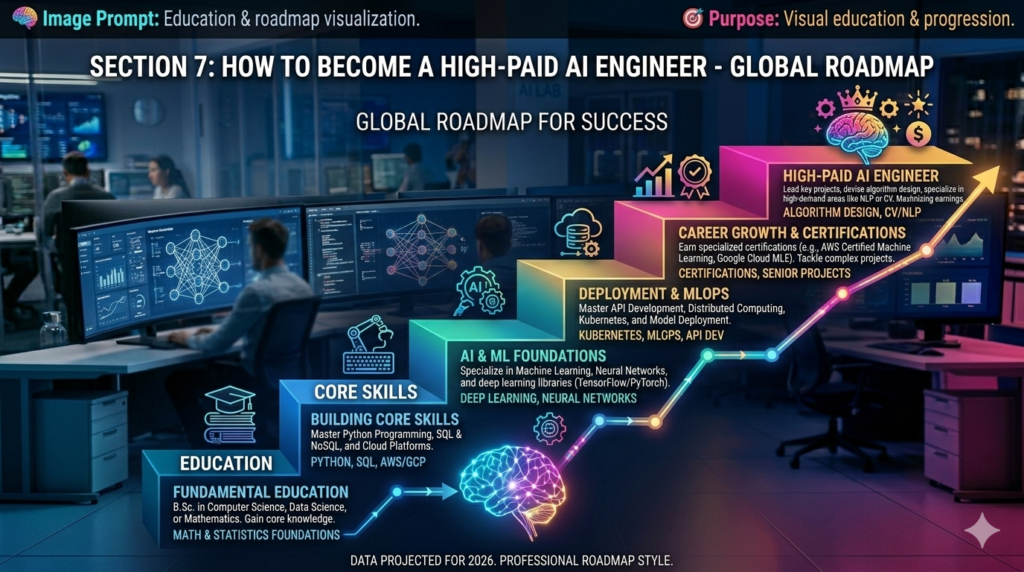
Your artificial intelligence career path begins with strong fundamentals. Learn mathematics, statistics, and algorithms. Then move into machine learning and deep learning projects.
Many professionals complete AI degree programs or pursue an MS in Artificial Intelligence. Others enter through bootcamps. The key is practical work.
Build real-world systems. Create AI tools. Deploy models on cloud computing platforms. Show recruiters you can handle full AI product development cycles.
A simple roadmap looks like this:
- Master Python programming
- Study neural networks
- Build predictive modeling projects
- Deploy using AWS or Azure
- Contribute to AI research communities
Consistency drives income.
Future of AI Careers
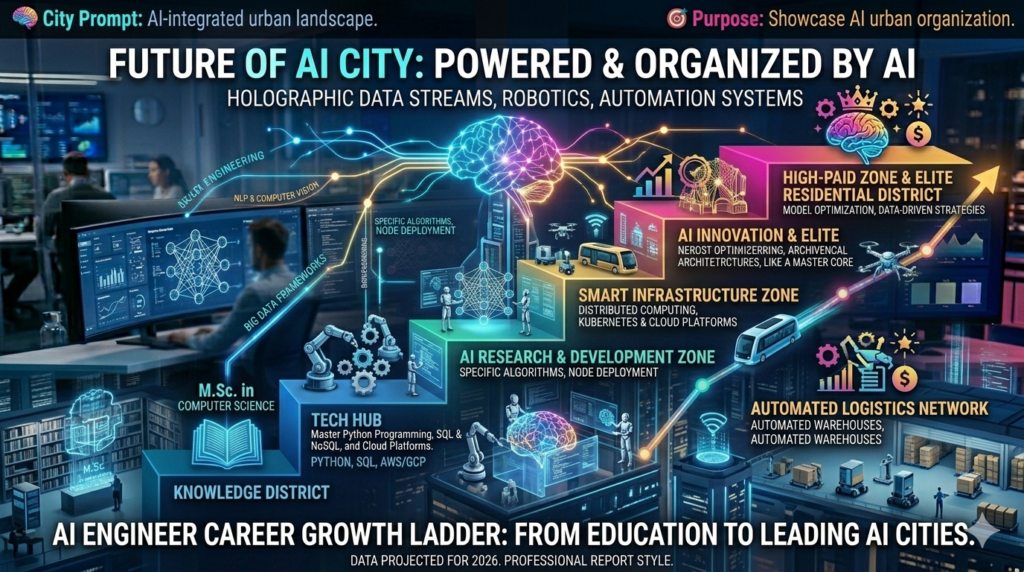
The future looks bright. AI career growth continues at record speed. Reports show double-digit hiring growth each year.
Several AI job market trends shape 2026 and beyond. Companies invest heavily in automation. AI industry trends show rising use of robotics and healthcare analytics. Businesses also scale AI through enterprise-wide AI deployment systems.
Experts predict the AI engineer salary 2026 will increase another 8–12 percent next year. As more industries adopt artificial intelligence, compensation will rise.
A senior engineer recently said:
AI isn’t just a tool. It’s becoming the engine of every modern company.
That statement reflects reality.
Global AI Job Market Trends 2026–2030
The AI job market isn’t warming up. It’s accelerating.
Between 2026 and 2030, artificial intelligence will move from competitive advantage to economic backbone. Companies won’t ask whether to adopt AI. They’ll ask how fast they can scale it. That shift changes everything for talent, hiring strategy, and global opportunity.
Let’s break it down.
Rising AI Job Demand Worldwide
Demand for AI professionals continues to surge across North America, Europe, the Middle East, and Asia. Roles in machine learning, data engineering, AI product strategy, and AI governance now sit at the center of digital transformation plans.
You’re no longer looking at niche tech hiring. Banks use AI for fraud detection. Retailers use it for predictive inventory. Logistics firms optimize routes in real time. Even law firms deploy AI for document review.
As adoption expands, companies compete fiercely for:
- Machine Learning Engineers
- AI Researchers
- Data Scientists
- AI Security Specialists
- Prompt Engineers
Talent shortages will widen. Salaries will rise. Remote hiring will normalize. Borders won’t matter as much as skill depth.
The Automation Surge
Automation won’t eliminate work. It will redefine it.
From smart factories to automated customer service systems, organizations will integrate AI into daily operations. Repetitive tasks will disappear. Strategic roles will grow.
Think of it this way: automation handles the predictable. Humans handle the complex.
This creates demand for professionals who can:
- Design automation systems
- Maintain AI pipelines
- Audit algorithmic decisions
- Align AI outputs with business goals
Companies that automate faster will scale faster. That reality pushes job growth in AI-adjacent roles even further.
AI Adoption in Developing Economies
Emerging markets won’t sit on the sidelines.
Countries in South Asia, Africa, and Southeast Asia increasingly adopt AI to solve infrastructure gaps, healthcare shortages, and financial inclusion challenges. Governments and startups invest in AI-powered agriculture, fintech platforms, and digital education systems.
For example, AI-driven crop monitoring improves yields. Fintech AI expands credit access. Telemedicine platforms use machine learning to triage patients in remote areas.
As adoption spreads, demand for local AI talent grows. That means new job hubs will rise outside traditional tech capitals. Opportunity becomes more distributed.
Robotics and Healthcare AI Expansion
Robotics will move beyond factory floors.
Advanced robotics combined with AI will transform logistics, manufacturing, and warehouse operations. Autonomous systems will improve efficiency while reducing operational risk.
Healthcare AI, however, may grow even faster.
AI-assisted diagnostics, predictive health modeling, drug discovery acceleration, and robotic surgery support systems will expand globally. Hospitals and research institutions will compete for AI specialists who understand both data science and medical systems.
The intersection of AI and life sciences will become one of the most powerful hiring engines of the decade.
Global Government Investment in AI
Governments understand the stakes.
Artificial intelligence now sits at the core of national competitiveness strategies. Countries allocate billions toward AI research, semiconductor manufacturing, defense applications, and digital infrastructure.
Public funding fuels:
- National AI research labs
- AI startup grants
- Workforce reskilling programs
- Ethical AI regulatory frameworks
When governments invest, ecosystems grow. Universities expand AI programs. Private capital follows. Job markets deepen.
USA vs Global Compensation Structure
| Region | Base Pay | Bonus | Equity | Total |
|---|---|---|---|---|
| USA Big Tech | High | High | High | Very High |
| Europe | Medium | Low | Medium | Medium |
| Middle East | High | Medium | Low | Medium-High |
| Asia | Medium | Low | Low | Medium |
What This Means for You
The next five years will reshape global employment patterns.
AI won’t remain a specialty. It will become foundational across industries. Demand will rise across borders. Automation will accelerate strategic hiring. Emerging economies will catch up faster than expected. Governments will keep pouring capital into innovation.
You must take information about: Tool Calculator – Free Online Calculators for Everyone
Is the USA Still the Best Market for AI Engineers?
Give a balanced analysis. Mention salary vs cost of living. Mention visa factors. Mention remote opportunities.
FAQs
Is AI a high paying job?
Yes. AI roles consistently rank among the highest-paid tech jobs in the US.
Which country pays AI engineers the most?
The United States currently offers the highest average compensation.
What is an entry-level AI salary?
Entry-level salaries start around $95,000 annually in 2026.
Can AI engineers earn $200k?
Yes. Senior engineers and AI architects often exceed $200,000.
AI engineer vs machine learning engineer salary
Machine learning engineers focus on models while AI engineers manage broader systems. Salaries are similar with slight variations based on specialization.
Final Thoughts
Artificial Intelligence Engineer Salary in 2026 shows strong growth in both the USA and global markets. With earnings ranging from $95,000 to over $200,000, AI remains one of the highest-paying tech careers. As demand for machine learning, deep learning, and AI deployment continues to rise, professionals with advanced skills can expect steady career growth and increasing global opportunities.

Zain Khan is the creator of Toolbolt.ink, providing fast, easy-to-use online tools for everyday conversions and calculations.